
The Ultimate Guide to JIS Screwdrivers: Why Japanese Industrial Standard Tools Are Essential for Precision Engineering
If you have ever worked on a Japanese motorcycle, a vintage Shimano bicycle component, a Tamiya RC car, or Japanese electronics, you have likely encountered a frustrating phenomenon: a stubborn screw that looks exactly like a standard Phillips, yet your premium Phillips screwdriver slips, rounds out, and completely ruins the screw head.
This destructive issue is rarely caused by user error or low-quality tools. Instead, it is the direct result of using the wrong tool for a specific engineering standard. What you are actually dealing with is a JIS (Japanese Industrial Standard) screw, and attempting to extract or tighten it with a traditional American or European Phillips tool is a recipe for stripped metal.
In this exhaustive 2000-word guide, we will break down everything you need to know about the JIS screwdriver, explore why you might really need a JIS screwdriver, look at exactly what it looks like, and examine the technical engineering behind Japanese Industrial Standard screwdrivers.
1. What is a JIS Screwdriver? Understanding the Core Technology
To answer the fundamental question—what is a JIS screwdriver?—we must look at the history of manufacturing standards. A JIS screwdriver is a precision hand tool specifically engineered to fit screws made under the Japanese Industrial Standard (JIS).
For decades, international manufacturing used localized specifications. While Western nations adopted the Phillips and Pozidriv standards, Japanese engineers developed a distinct fastening system optimized for high torque, automated assembly lines, and zero “cam-out.”
The Japanese Industrial Standard screwdriver is designed to seat completely flush within a genuine Japanese industrial standard screw. Because of its exact geometric profiling, it locks into the cross-slot of the fastener with zero play, providing a perfect mechanical interface that distributes rotational force evenly across all four wings of the screw head.
2. JIS Screwdriver vs. Phillips: The Critical Geometric Differences
At a casual glance, a JIS standard screwdriver looks identical to a standard Phillips screwdriver. However, under a magnifying glass or a digital caliper, the structural variances become strikingly clear.
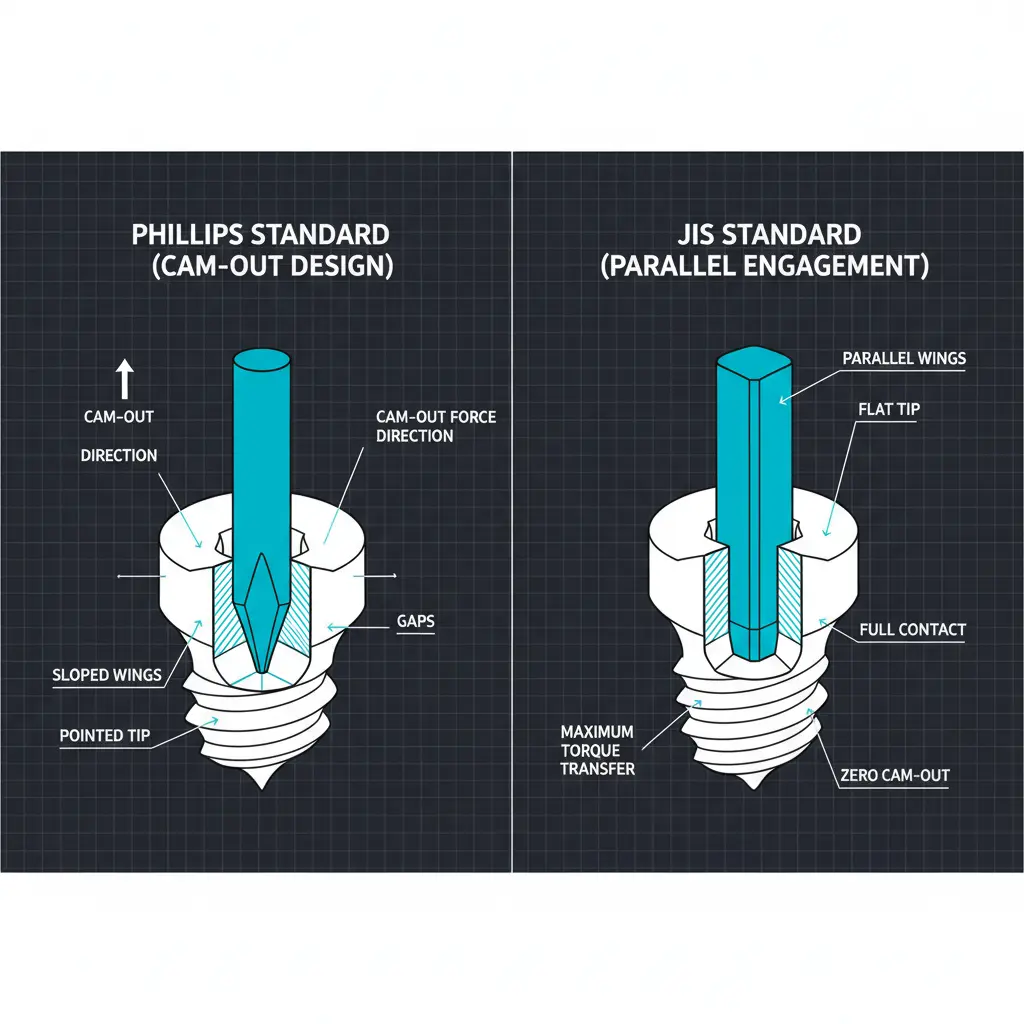
The Anatomy of a Phillips Screw
The classic Phillips design was intentionally engineered in the 1930s to “cam out.” During early industrial manufacturing, assembly line power tools did not have adjustable clutches. To prevent workers from over-tightening screws and snapping the shanks or stripping the threads, the Phillips screw was designed with sloped internal walls. When torque reaches a certain threshold, the Phillips screwdriver tip naturally climbs up and pushes itself out of the screw head.
The Anatomy of a JIS Screw
Conversely, the Japanese standard screwdriver and its corresponding screw reject the concept of cam-out entirely. Japanese manufacturing philosophy emphasizes precision tolerances and maximum torque efficiency.
-
Parallel Cross-Slots: The wings of a screwdriver JIS tip have perfectly parallel walls with a sharp, crisp profile.
-
Sharp Internal Corners: Unlike the rounded internal radius of a Phillips tip, a JIS screwdriver features square, sharp corners.
-
Shallower Well Depth: The central point of a JIS standard screwdriver is flatter and shorter than a Phillips.
When you insert a Phillips driver into a JIS screw, the pointed nose of the Phillips hits the shallow bottom of the JIS cross-slot before the wings can fully engage. This leaves a microscopic gap between the tool and the fastener walls. The moment you apply torque, the sloped Phillips wings lift right out of the slot, destroying the screw profile.
3. Do You Really Need a JIS Screwdriver?
The short answer to do you really need a JIS screwdriver? is: Yes, absolutely—if you work on any machinery, equipment, or vehicles manufactured in Japan.
Many technicians and DIY enthusiasts try to bypass buying specialized JIS tools by applying heavy downward pressure on a standard Phillips driver. While this might work on loose or lubricated fasteners, it fails miserably on factory-sealed, loctited, or corroded screws.
Industries Where JIS Tools Are Mandatory:
-
Automotive and Powersports: If you own a Honda, Yamaha, Kawasaki, Suzuki, or Mazda, your engine casings, carburetors, brake reservoirs, and body panels are held together almost exclusively by Japanese industrial standard screws.
-
Bicycle Maintenance: Vintage and modern bicycle components from brands like Shimano utilize precise Japanese standards.
-
Consumer Electronics: Classic gaming consoles (Sega, Nintendo), vintage audio gear (Sony, Pioneer), and modern camera rigs rely on micro-sized jis 00 screwdriver and jis 000 fasteners.
-
RC Vehicles and Modeling: High-end radio-controlled kits from manufacturers like Tamiya are notorious for using metric hardware that regular Phillips tools will strip instantly.
4. Visual Identification: Can You Show Me What It Looks Like?
A very common query among mechanics is: “Can you show me what it looks like?” Visual identification is crucial because mistaking a JIS screw for a Phillips screw can cost you hours of extra labor extracting drilled-out hardware.
How to Identify a JIS Screw Head
Look closely at the face of the cross-head screw. A genuine JIS screw will typically feature a single, distinct raised dot or a small dimple stamped onto one of the four quadrants between the slots.
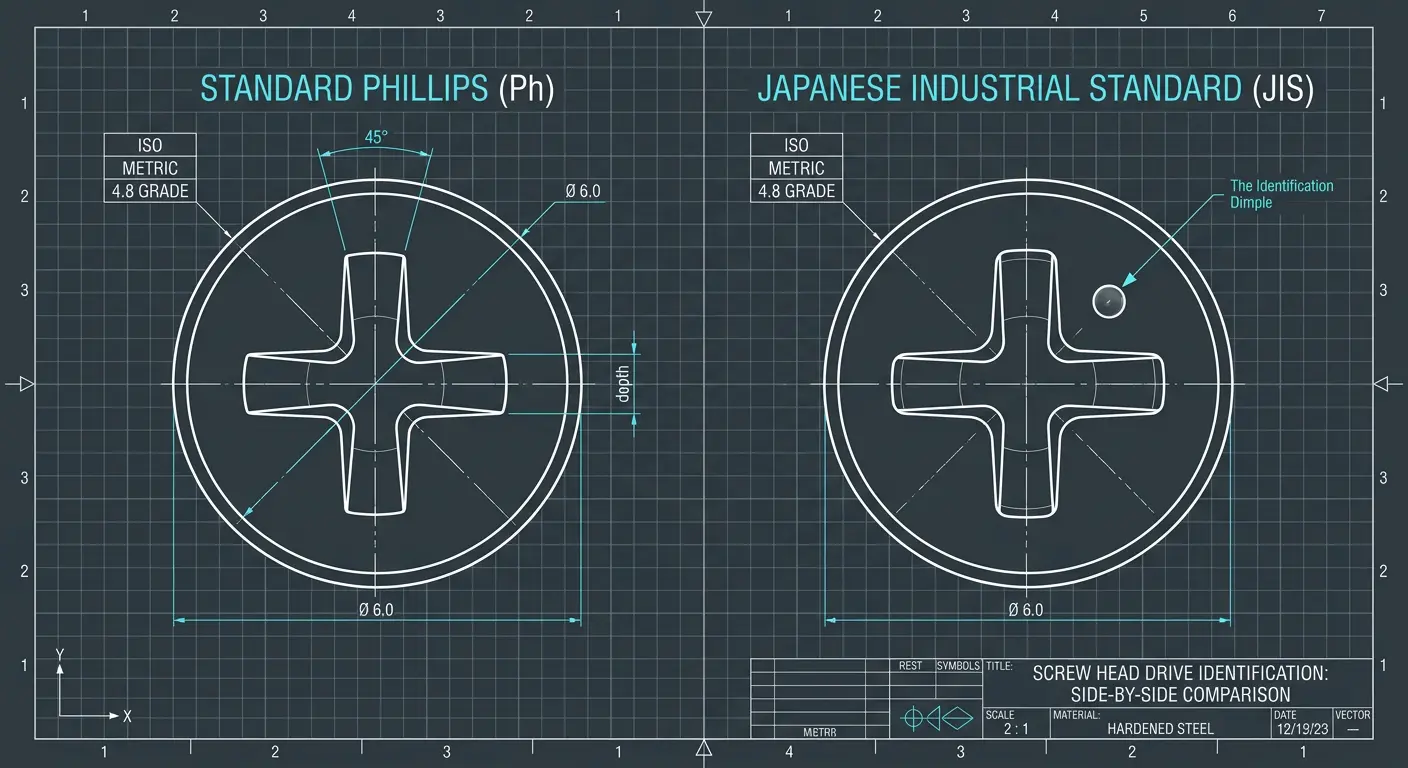
When looking directly at a screwdriver japanese design versus a Western design:
-
The tip looks noticeably “flatter” at the very point.
-
The edges of the blades feel sharper to the touch.
-
When placed inside a JIS screw, the tool will balance perfectly on its own without wobbling or shifting from side to side.
5. Navigating JIS Screwdriver Sizes and Specifications
Just like the Phillips numbering system (PH000, PH00, PH1, PH2, PH3), jis screwdriver sizes follow a rigid hierarchy tailored to different scales of engineering. Selecting the correct size ensures that the surface area contact between the tool blade and the fastener is fully maximized.
Micro and Electronics Sizes (JIS 000 and JIS 00)
-
JIS 000: This is the smallest precision standard, used primarily in micro-electronics, smart devices, optical equipment, and high-end watches. A premium jis 000 driver allows you to manipulate minuscule screws without applying excessive downforce that could crack delicate circuit boards.
-
JIS 00: Slightly larger than the triple-zero, the jis 00 screwdriver is the staple tool for laptop repairs, camera lens assemblies, and small RC drone chassis.
Standard Mechanical Sizes (JIS No. 1, No. 2, and No. 3)
-
JIS No. 1: Commonly found on small engine brackets, interior automotive dash pieces, and medium-sized electronic appliances.
-
JIS No. 2: The single most crucial size for anyone working on vehicles or machinery. The jis screwdriver size No. 2 is found on motorcycle engine case screws, carburetor bowls, master cylinders, and bicycle derailleurs. If you can only buy one size, this is the one to get.
-
JIS No. 3: Designed for heavy-duty industrial applications, large structural brackets, and heavy machinery fasteners that demand immense breakaway torque.
6. The Complete Guide to High-Quality JIS Screwdriver Sets
Investing in a dedicated jis screwdriver set is a definitive turning point for any serious workshop. Rather than buying individual pieces piecemeal, a structured set gives you cross-spectrum compatibility across micro-electronics and heavy mechanical components.
What to Look For in a Premium JIS Set:
-
Hollow Ground Blades: Top-tier japanese screwdrivers feature hollow-ground or precision-milled tips that resist twisting under high loads.
-
Magnetic Tips: Given that many Japanese machine designs feature deep, narrow recesses (such as deep-set carburetor jets), a magnetized tip is invaluable for retrieving loose fasteners.
-
Impact-Ready Shanks: For stubborn, rusted engine casings, look for a jis screwdriver set that features a “go-through” steel shank terminating in a metal striking cap. This allows you to hit the back of the handle with a hammer to shock the threads loose while simultaneously turning the tool.
7. Legendary Japanese Tool Brands: Real Engineering Excellence`
When it comes to sourcing genuine jis tools, looking directly to established manufacturers in Japan guarantees compliance with the authentic DIN/JIS design framework. Several legendary brands dominate this sector, producing hand tools with world-renowned metal tempering and ergonomic engineering.
Vessel Tools
Vessel tool is arguably the pioneer of the japanese screwdriver industry. They have been manufacturing world-class striking drivers, ball-grip drivers, and precision electronic sets for over a century. Their patented “Megadora” series handles offer extreme grip in oily environments, making them a favorite among professional motorcycle mechanics.
Anex (Kaneko Manufacturing)
Anex tool produces highly specialized precision japanese screwdrivers optimized for delicate work. Their micro-driver lineup features ultra-smooth rotating end caps, allowing technicians to apply constant axial pressure while spinning the tool body with their fingertips.
Engineer Inc.
Famous for their “Neojiros” screw extraction pliers, Engineer Inc. also produces premium jis screwdrivers built with extremely tough chrome vanadium steel, designed to withstand the rigors of heavy industrial environments.
8. The Modern Evolution: DIN ISO 8764 and the "New" Cross-Slot Standard
A significant point of confusion in the modern tool market surrounds the phrase “JIS 211” or “Japan Industrial Standard Screwdriver” documentation updates.In recent years, the official Japanese Industrial Standard archives formally retracted the standalone designation for JIS cross-recess screws in an effort to harmonize international standards with global ISO metrics. The old JIS standard was integrated under the updated DIN ISO 8764 standard.
What Does This Mean for the Buyer?
Modern top-tier Japanese brands often mark their packaging with “Fits JIS” or “JA” (Japanese Application) rather than printing the word “JIS” directly on the tool. Newer tools are meticulously engineered to be cross-compatible; they fit legacy jis standard screwdrivers specifications perfectly, while also engaging with standard Western Phillips screws without causing damage.
Therefore, if you purchase a modern precision tool set from a certified Japanese brand like Vessel, it will naturally function as a true jis screwdriver despite updated global labeling compliance.
9. How to Avoid Stripping Screws: A Step-by-Step Maintenance Protocol
Possessing the correct screwdriver japanese tool is only half the battle. To guarantee you never ruin a classic Japanese machine or a delicate piece of electronics, follow this professional technician protocol:
Step 1: Clean the Screw Recess
Japanese machinery used outdoors or in greasy engine bays naturally collects dirt, grit, and oxidized metal inside the cross-slot. Use a fine brass wire brush or a pick to clear out any debris. If the recess is clogged, your jis standard screwdriver tip cannot seat fully to the bottom, which re-introduces the risk of slipping.
Step 2: Test the Fit Interlocking
Insert your jis screwdriver into the head. Gently wiggle it back and forth. If it feels solid, locks tightly, and can hold its own weight horizontally without dropping out of the screw head, you have a perfect mechanical match.
Step 3: Apply the 80/20 Rule of Torque
When breaking loose a stubborn factory-tightened Japanese fastener, apply 80% downward force and only 20% turning force. This massive downward load prevents the tool from shifting vertically, ensuring all your rotational rotational force is safely transferred through the parallel side-walls of the fastener.
10. Summary Checklist: The Essential Guide to Japanese Industrial Fasteners
To wrap up this comprehensive deep dive, let’s consolidate the critical differences into a highly actionable reference guide:
| Technical Feature | Standard Phillips Screwdriver | Genuine JIS Screwdriver |
| Primary Design Intent | Engineered to slip/cam out under load to prevent over-tightening. | Engineered for absolute parallel lockup and maximum high-torque transfer. |
| Tip Profile Configuration | Highly pointed nose tip with sloped, radiused internal wing walls. | Blunted, flat nose tip with completely vertical, sharp parallel wing walls. |
| Fastener Stamping Marks | Completely clean cross-slot with no auxiliary markings. | Stamped with a single raised dot or a small compression dimple. |
| Optimal Micro Applications | Standard domestic appliance repairs, drywalls, and general framing. | jis 00 screwdriver and jis 000 for cameras, electronics, and precision RC systems. |
| High-Torque Performance | High risk of stripping out heads when dealing with corrosion or Loctite. | Extreme stability; ideal for heavy powersport casings and metric machinery. |
11. Final Verdict: Protecting Your Investments with Genuine JIS Tools
At the end of the day, using an ordinary Phillips tool on a highly precise japanese industrial standard screw is a gamble that inevitably leads to stripped metal, ruined parts, and endless frustration.
Whether you are looking for a heavy-duty jis screwdriver set to tear down a vintage 1970s motorcycle carburetor, or a delicate jis 000 driver to fix a premium mirrorless camera system, adding dedicated jis tools to your workshop inventory is a necessity. By respecting the engineering intentions of the Japanese Industrial Standard, you save time, prevent damage, and ensure that your mechanical work mirrors the clean, precise execution of the engineers who designed the machinery in the first place.
